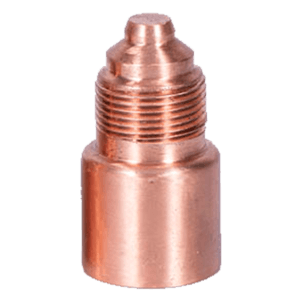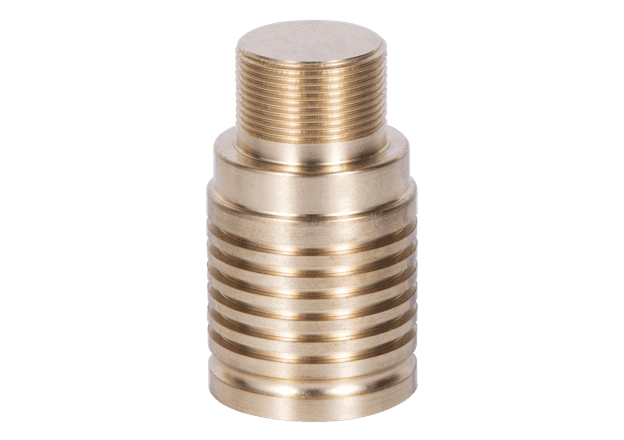
H59 brass is the most economical type of brass, known for its high strength, hardness, and good plasticity. It performs well under pressure processing, even in a hot state, and exhibits general corrosion resistance, with properties similar to H62.
Mechanical Properties
Tensile Strength (σb): ≥ 294 MPa
Elongation (δ10): ≥ 25%
Note: These tensile mechanical properties apply to plates with a thickness of 0.5 to 15 mm.
Microstructure
Room Temperature Structure: Ordinary brass is a copper-zinc binary alloy with varying zinc content, leading to different microstructures:
α Brass: Zinc content below 35%, consisting of a single-phase α solid solution.
(α + β) Latón: Zinc content between 36% and 46%, consisting of two phases (α and β).
β Brass: Zinc content above 46% to 50%, consisting solely of the β phase.
Pressure Processing Performance:
Alpha Single-Phase Brass (H96 to H65): Exhibits good plasticity and can withstand both hot and cold processing. However, it is prone to medium-temperature brittleness during hot processing (forging) at temperatures generally between 200°C and 700°C. To avoid brittleness, hot processing should occur above 700°C. The brittleness is attributed to the presence of ordered compounds (Cu3Zn and Cu9Zn) within the α-phase and low melting point eutectic films formed by trace elements like lead and bismuth.
Two-Phase Brass (H63 to H59): Contains both α-phase with good plasticity and a β-solid solution. The β-phase has high plasticity at elevated temperatures, while the β′-phase (ordered solid solution) is hard and brittle at lower temperatures. Thus, (α + β) brass should be forged in a hot state. Brass with more than 46% to 50% zinc (β brass) is hard and brittle and cannot be pressure processed.
Mechanical Properties Variation: The mechanical properties of brass vary with zinc content:
For α brass, both tensile strength (σb) and elongation (δ) increase with higher zinc content.
For (α + β) brass, room temperature strength increases with zinc content up to about 45%, beyond which strength decreases sharply due to the formation of the brittle r-phase (Cu5Zn8 compound). The plasticity of (α + β) brass decreases with increasing zinc content, making copper-zinc alloys with over 45% zinc impractical.
Applications
Common brass is widely used in applications such as:
Water tank belts
Water supply and drainage pipes
Medallions
Bellows
Serpentine pipes
Condensation tubes
Shells
Various complex punching products
Small hardware
As zinc content increases from H63 to H59, these brasses can effectively withstand hot processing and are often used in machinery and electrical appliance parts, stamping parts, and musical instruments.
Heat Treatment
Hot Working Temperature: 730–820°C
Annealing Temperature: 600–670°C
Proceso de pedido
Q1: Cómo enviar una solicitud de procesamiento?A: Puedes contactar con nosotros vía WhatsApp: +86 15323729231 or email [email protected].B: Admitimos formatos de archivo STEP/STL/IGES. También puedes enviar tus archivos a nuestro correo electrónico de servicio.. Nuestro sistema generará una cotización y procesará las recomendaciones dentro de 1 hora.
Q2: ¿Ofrecen sugerencias de optimización del diseño??A: Sí! Nuestro equipo de ingeniería ofrece un DFM gratuito (Diseño para la fabricabilidad) revisar, Proporcionar sugerencias de optimización para mejorar la estructura y reducir costos..
Precios & Entrega
Q3: ¿Cuál es la cantidad mínima de pedido? (Cantidad mínima de pedido)?A: Sin cantidad mínima de pedido! Aceptamos pedidos a partir de 1 pedazo, ya sea para impresión 3D o mecanizado CNC.
Q4: ¿Qué está incluido en la cotización??A: El presupuesto cubre los costes de material., tarifas de procesamiento, y tratamiento superficial básico (P.EJ., chorro de arena). Procesos adicionales (P.EJ., galvanoplastia, anodizado) se cotizará por separado.
Q5: ¿Cuál es el plazo de entrega estándar??
- Mecanizado CNC: 3-5 días (arriba a 7 días para piezas complejas)
- 3Impresión D: 72 horas
Tecnología & Calidad
Q6: ¿Cuál es la precisión del mecanizado??
- Mecanizado CNC: Creación rápida de prototipos con una tolerancia de ±0,05 mm, 0.1tolerancia de forma mm, y rugosidad de la superficie Ra1.6 o mejor.
- 3Impresión D:
- Piezas de resina: ±0.2mm
- Nylon parts: ±0,3 mm
- Plastic parts: ±0,3 mm
- Metal parts: ±0,3 mm
P7: ¿Qué materiales apoya??✅ CNC Machining:
- Aleación de aluminio: 6061, 7075
- Aleación de cobre: Latón (H59), Cobre rojo (T2)
- Acero aleado: 45# Steel
- Acero inoxidable: SUS304
- Plastics:
- Abdominales (Blanco, Negro)
- Pom (Blanco, Negro)
- Baquelita (Negro, Naranja)
- Acrílico (Transparente)
- Tablero epoxi FR4 (Verde)
- Nailon PA6 (Blanco)
- policarbonato (Transparente)
✅ 3D Printing:
- Resina, Nylon, Plásticos de ingeniería, Acero inoxidable
Servicio postventa
P8: ¿Qué pasa si las piezas no cumplen con los requisitos??A: Si se producen defectos debido a nuestros problemas de procesamiento, Garantizamos remanufactura gratuita..