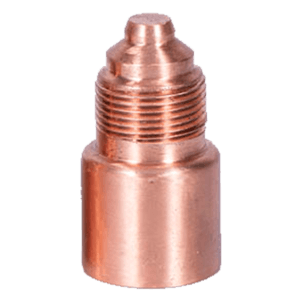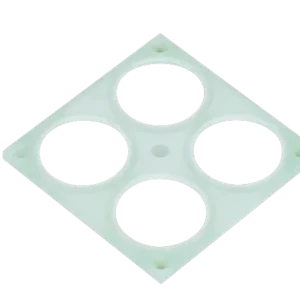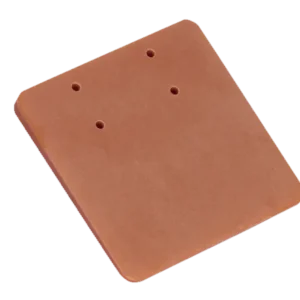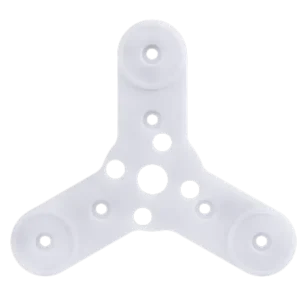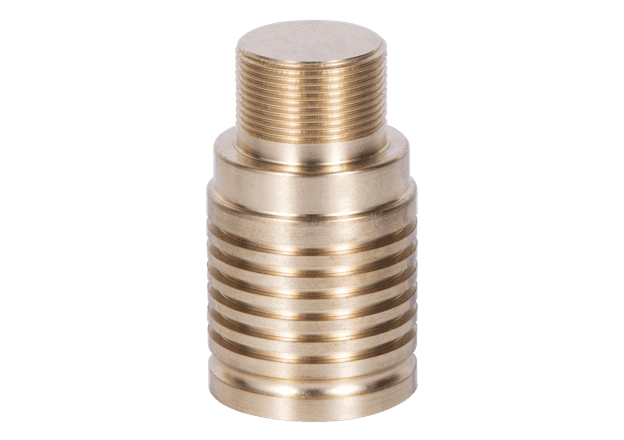
H59 brass is the most economical type of brass, known for its high strength, hardness, and good plasticity. It performs well under pressure processing, even in a hot state, and exhibits general corrosion resistance, with properties similar to H62.
Propriétés mécaniques
Résistance à la traction (σb): ≥ 294 MPa
Elongation (δ10): ≥ 25%
Note: These tensile mechanical properties apply to plates with a thickness of 0.5 to 15 MM.
Microstructure
Room Temperature Structure: Ordinary brass is a copper-zinc binary alloy with varying zinc content, leading to different microstructures:
α Brass: Zinc content below 35%, consisting of a single-phase α solid solution.
(α + β) Laiton: Zinc content between 36% and 46%, consisting of two phases (α and β).
β Brass: Zinc content above 46% to 50%, consisting solely of the β phase.
Pressure Processing Performance:
Alpha Single-Phase Brass (H96 to H65): Exhibits good plasticity and can withstand both hot and cold processing. However, it is prone to medium-temperature brittleness during hot processing (forging) at temperatures generally between 200°C and 700°C. To avoid brittleness, hot processing should occur above 700°C. The brittleness is attributed to the presence of ordered compounds (Cu3Zn and Cu9Zn) within the α-phase and low melting point eutectic films formed by trace elements like lead and bismuth.
Two-Phase Brass (H63 to H59): Contains both α-phase with good plasticity and a β-solid solution. The β-phase has high plasticity at elevated temperatures, while the β′-phase (ordered solid solution) is hard and brittle at lower temperatures. Thus, (α + β) brass should be forged in a hot state. Brass with more than 46% to 50% zinc (β brass) is hard and brittle and cannot be pressure processed.
Mechanical Properties Variation: The mechanical properties of brass vary with zinc content:
For α brass, both tensile strength (σb) and elongation (δ) increase with higher zinc content.
For (α + β) brass, room temperature strength increases with zinc content up to about 45%, beyond which strength decreases sharply due to the formation of the brittle r-phase (Cu5Zn8 compound). The plasticity of (α + β) brass decreases with increasing zinc content, making copper-zinc alloys with over 45% zinc impractical.
Applications
Common brass is widely used in applications such as:
Water tank belts
Water supply and drainage pipes
Medallions
Bellows
Serpentine pipes
Condensation tubes
Shells
Various complex punching products
Small hardware
As zinc content increases from H63 to H59, these brasses can effectively withstand hot processing and are often used in machinery and electrical appliance parts, stamping parts, and musical instruments.
Heat Treatment
Hot Working Temperature: 730–820°C
Annealing Temperature: 600–670°C
Processus de commande
T1: Comment soumettre une demande de traitement?UN: Vous pouvez nous contacter via WhatsApp: +86 15323729231 ou par email [email protected].B: Nous prenons en charge les formats de fichiers STEP/STL/IGES. Vous pouvez également envoyer vos fichiers à notre service email. Notre système générera un devis et traitera des recommandations dans les délais 1 heure.
T2: Fournissez-vous des suggestions d'optimisation de la conception?UN: Oui! Notre équipe d'ingénieurs propose un DFM gratuit (Conception pour la fabricabilité) revoir, fournir des suggestions d'optimisation pour améliorer la structure et réduire les coûts.
Tarifs & Livraison
T3: Quelle est la quantité minimum de commande (MOQ)?UN: Pas de quantité minimale de commande! Nous acceptons les commandes à partir de 1 morceau, que ce soit pour l'impression 3D ou l'usinage CNC.
T4: Ce qui est inclus dans le devis?UN: Le devis couvre les frais de matériel, frais de traitement, et traitement de surface de base (Par exemple, sablage). Processus supplémentaires (Par exemple, galvanoplastie, anodisation) sera cité séparément.
Q5: Quel est le délai de livraison standard?
- Usinage CNC: 3-5 jours (jusqu'à 7 jours pour pièces complexes)
- 3D Impression: 72 heures
Technologie & Qualité
Q6: Quelle est la précision d'usinage?
- Usinage CNC: Prototypage rapide avec une tolérance de ±0,05 mm, 0.1tolérance de forme en mm, et rugosité de surface Ra1,6 ou mieux.
- 3D Impression:
- Pièces en résine: ±0,2 mm
- Pièces en nylon: ±0,3 mm
- Pièces en plastique: ±0,3 mm
- Pièces métalliques: ±0,3 mm
Q7: Quels matériaux soutenez-vous?✅Usinage CNC:
- Alliage d'aluminium: 6061, 7075
- Alliage de cuivre: Laiton (H59), Cuivre rouge (T2)
- Acier allié: 45# Acier
- Acier inoxydable: SUS304
- Plastiques:
- ABS (Blanc, Noir)
- POM (Blanc, Noir)
- Bakélite (Noir, Orange)
- Acrylique (Transparent)
- Panneau époxy FR4 (Vert)
- Nylon PA6 (Blanc)
- Polycarbonate (Transparent)
✅ Impression 3D:
- Résine, Nylon, Plastiques techniques, Acier inoxydable
Service après-vente
Q8: Que faire si les pièces ne répondent pas aux exigences?UN: Si des défauts surviennent en raison de nos problèmes de traitement, nous garantissons une remise à neuf gratuite.